 Primary attention in the real economy
Here we outline a basic threefold division of attention in a curriculum of living economy, which map an extended ontology of ‘material’. We do this in terms of families of patterns (schools) of wild nature, domestic economy and digital means. These are understood to be responses to the Anthropocene, colonialism-capitalism, and 'The Golemic'.
The material in each of these divisions has a distinct form, with which we can have distinctly different kinds of relations. In other words, this 'structure map' below is an intrinsically *relational* mapping of the world of the real economy.
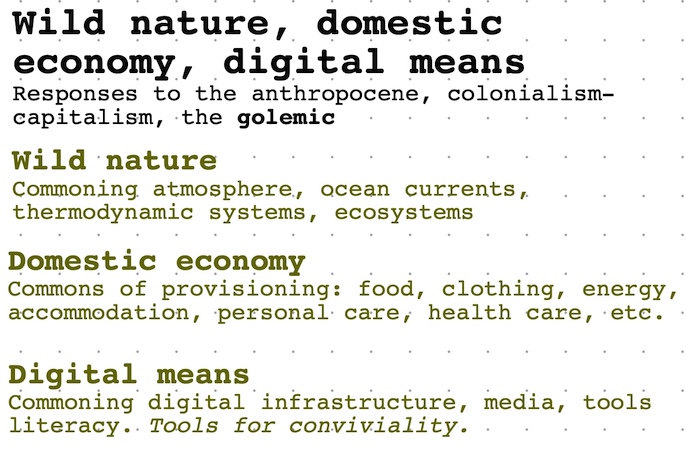
A curriculum of the living economy - A threefold division of attention
Expressed in terms of families of pattern in a pattern language - which also identify schools in an emergent 'college' - these three fields are:
- Patterns of practice engaging (ie commoning) **wild nature** - Ocean, forest, air, water, climate, icecap, weather systems, currents, thermodynamic balances. *Natural means that have been taken for granted as unlimited (’the bounty of nature’), whose limits of stability and carrying capacity are manifestly being transgressed, and which need actively to be brought under commons stewardship.* Wild nature and the Anthropocene
- Patterns of practice engaging (ie commoning) **domesticated economy** *Humanly-cultivated and -fashioned constellations of means of subsistence and wellbeing: housing and land for housing, regional food, personal care of dependents, medical care, transport, energy, etc.* Each is a complex field, with its own material organisation, and practical relations and motivations, warranting stewarding as commons. Domesticated economy and capitalisms
- Patterns of practice engaging (ie commoning) **digital means** - Media, apps infrastructure (platforms), devices and architectures/networks of devices, transport infrastructure, protocols, means of generating and holding data, and crunching ‘wild’ data (analytics, ‘Big’ corpora). Digital means and the Golemic
# Historical relationships with 'the materiall' Historically, all of these are large and problematic fields. The point is, some kind of ontology of material, and relationships with kinds of material, is arguably called for, to handle the kinds of challenges in deep evolutionary-revolutionary time that ‘living economy’ is de facto responding to.
In all the fields of material relationship above, and those below, the central concern of the schools of the college is identifying dominant relations of production, and patterns of practice that bring altered relations of production into force.
In the field of ‘domesticated’ economy, some version of capital-colonial dominance and enclosure constitutes relations of production. Just how relations of production are best characterised in relationships with wild nature and with digital means are matters of ongoing enquiry, through the schools’ pattern language(ing) practice.
Augmenting the three core framings of wild nature, domesticated economy and digital means, there are two further kinds of division that seem helpful in the landscape of material provision.
If the primary - material - 'real economy' of provisioning is the first division, the second division comprises ‘machineries’ which, while social-cultural in their material composition (just as the labour-processes of domesticated economy are), are technologies of *organising* provision and access, rather than of materially provisioning. They are intended to run either as much ‘like machines’ as possible or, sometimes, *as* hugely extended (digital) machines. Machineries of intermediation
And the third division comprises relationships with material that are boundary-crossing (transgressive, cyborg, monstrous?) with regard to the threefold form of the real economy. Transgressive and cyborg means
--- Next: Machineries of intermediation
As schools in a Faculty of subsistence work, the above sit in this kind of relationship . .
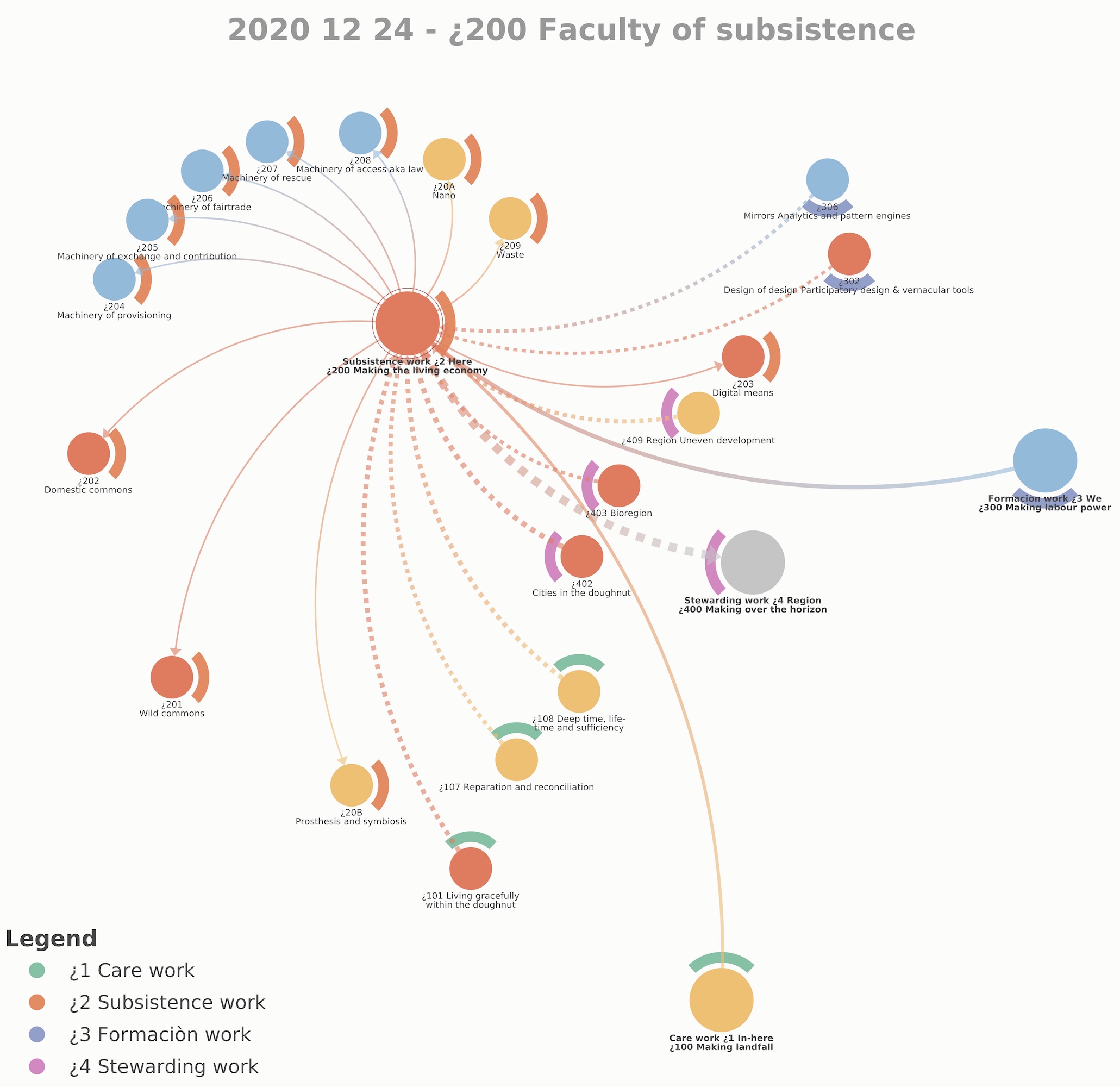
Faculty of subsistence work - Schools and interfaculty links