
Here we sketch three boundary-crossing fields of practice with relationships that are problematic enough - pathological - to warrant particular attention in the making living economy. Each of them has a family of patterns, a school.
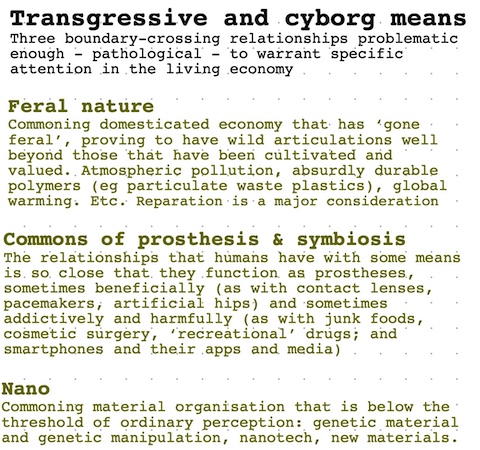
Means of subsistence and wellbeing - Fields of transgressive relationship
In each case - the school of Feral nature, Prosthesis and symbiosis, Nano - the challenges are . .
- first, to identify relations of production in these fields of practice (often perhaps lying in landscape §3), and
- second to identify practical ways in which practice in relation to such means can be conducted in a *commons*: that is, under commons stewarding.
> It might be, for example, that some elaboration of ‘design circle’ formations is a place to start. But the movement for the commons has lots to bring to such questions, even if here we’re dealing essentially with aesthetic matters (of wellbeing) rather than subsistence.
This stuff is all a bit weird, and off the beaten track: well outside any kind of commonsense. I think this is why it has to be in the curriculum of a college of activist formaciòn. This kind of literacy isn't just hanging on trees, waiting to be harvested.
# Commoning feral nature This is domesticated economy that has ‘gone feral’ proving to have wild articulations well beyond those that have been cultivated and valued: atmospheric pollution, absurdly durable polymers (particulate waste plastics in oceans and the food chain), global warming. Etc. Matters of reparation are prominent here.
Twenty years ago Robin was making a start on the economics of this (*Wealth from waste* 1999, *Zero waste* 2002). Extinction Rebellion and #FridaysforFuture have hemmered it home. But there are many patterns yet to be rigorously identified and enacted. The wellbeing of our grandchildren's granchildren depsend on them.
> Be aware, builders at work. More to be developed here xxx
# Commoning of prosthesis and symbiosis The relationships that humans have with some means is so close that they function as prostheses, sometimes beneficially (as with contact lenses, pacemakers, artificial hips) and sometimes addictively and harmfully (as with junk foods, cosmetic surgery, ‘recreational’ drugs; and smartphones and their apps and media). There are questions about whether and in what ways these are ’needs’ or means of wellbeing: addiction, as distinct from necessity and skilful, intentional dependence.
This same school could engage also with Companion species: the almost symbiotic relationships that our species has with non-human species. In both cases there are questions regarding where ‘the human’ ends and what kinds of distributed identity or existence are constructed (addictively, dependently, beneficially? inescapably? and who says?) across species and across the spectrum of human and non-living entities.
These practices clearly are strongly present in landscape §3; but the de facto production of many of them is deep down in the belly of the received economy and the mechanics of available ‘stuff’ (not to mention pharmaceutical capitalism, for example), while the efficacy of some others in generating trans-species wellbeing is barely considered, and is certainly ‘not economic’ in any direct sense.
> Be aware, builders at work. More to be developed here xxx
# Commoning nano We’ve been in the nano era for more than a century - it began with the first plastics, when molecular structures were modified or synthesised on a industrial scale, creating materials with ‘unnatural’ properties. T
his is the origin of the absurdly durable plastics that now are going feral. But practices of modifying and generating materials and living organisms or organs at the atomic, molecular, genetic or cellular level are set to ramp-up enormously - all the way from graphene and 3D-printed organic semiconducting fabrics, via GM crops (and patent-protected heritage species), to designer-eugenics and mood cosmetics.
Human capabilities for both valuing such practices and for containing the resulting materials (*pace* plastics in the oceanic food chain, planet-wide) are far too far away from the capability to make them, for our grandchildren’s grandchildren to sleep safe at nights.
This perspective sits within the ‘over the horizon and under the radar’ frame of the Faculty of stewarding. But it makes practical sense for the school to live alongside other materials- and provisioning-oriented families. It sits very close to the schools of Digital means and the Golemic, for example.
> Be aware, builders at work. More to be developed here xxx